Panera Bread Menu
Independent guide to Panera menu prices and calories Not affiliated with Panera Bread
Independent guide Not affiliated with Panera Bread
Independent guide to Panera menu prices and calories Not affiliated with Panera Bread
Independent guide Not affiliated with Panera Bread
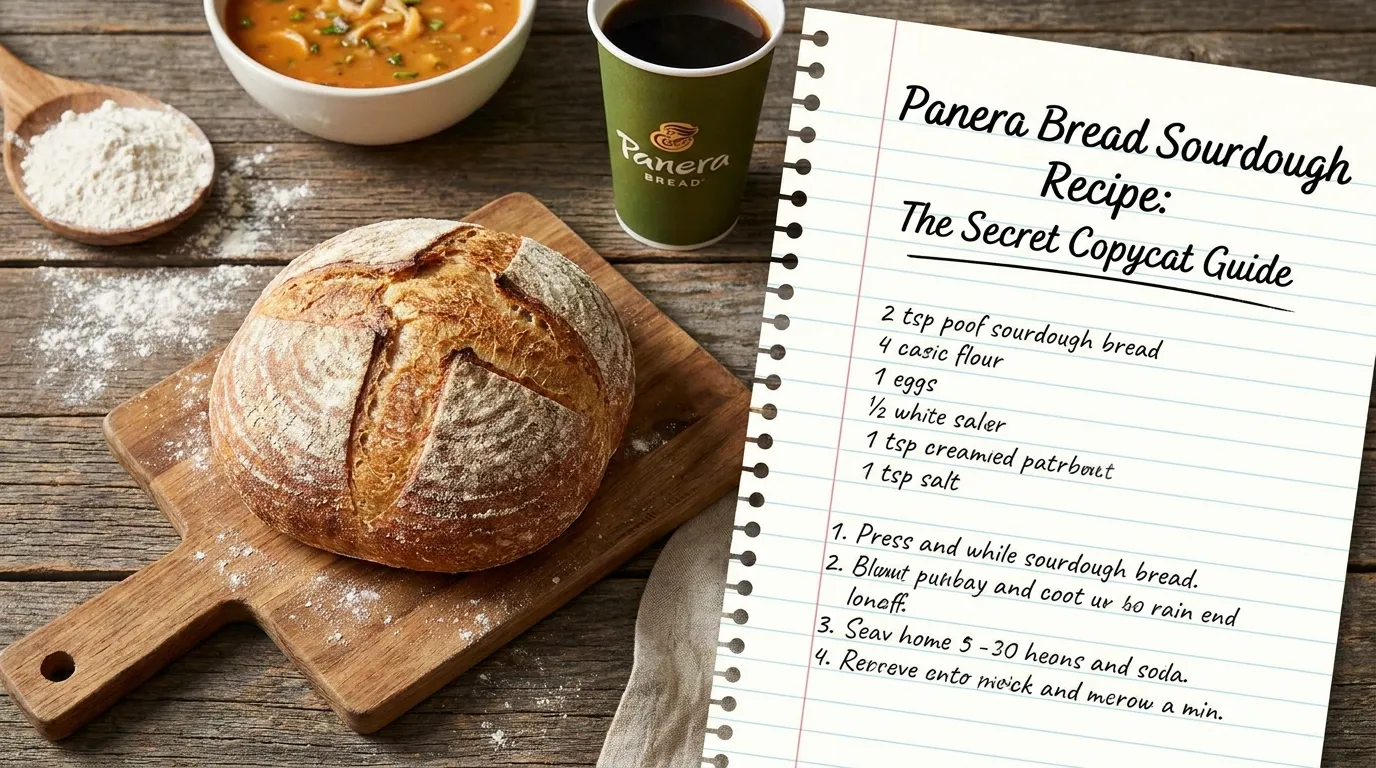
Recreate the signature golden-brown, crackly crust and deep wild yeast tang of the legendary Panera bread bowl right in your home kitchen. Using a 24-hour slow fermentation process, five simple ingredients, and basic pans, you can achieve professional bakery results for under five dollars total.
Ensure your starter is at its peak (doubled and full of active bubbles) before mixing.
Use a preheated water tray in your oven to create steam for that signature thin, crackly crust.
Score the dough at a shallow 45-degree angle. This directs the rise and prevents bursting.
Let the bread cool for at least 2 hours. Sourdough continues baking and setting its crumb as it cools.
Use King Arthur Bread Flour for the highest protein content and perfect gluten structure.
Tap each step as you complete it to track your baking progress
Feed your sourdough starter. It must be double in size, airy, and float when dropped in water before you mix it with the flour.
Baker Tip: Use a warm spot (75°F to 78°F) to ensure your starter reaches peak fermentation activity quickly.
Stir flour, water, and active starter until a rough dough forms with no dry spots. Cover and let rest for 30 minutes to autolyse.
Baker Tip: This rest period allows the flour to hydrate naturally, making it much easier to knead and fold later.
Add salt and honey. Work the dough by pulling the sides up and folding them over the center. Repeat this set every 30 minutes 4 times.
Baker Tip: Dampen your hands with water to prevent the wet sourdough from sticking to your fingers.
Divide the dough into 4 equal rounds. Gently roll each round on the counter with a bench scraper to create a tight, smooth outer skin.
Baker Tip: A strong surface tension is what gives the bread bowls their round shape and dramatic rise.
Place shaped dough upside down in floured baskets or towels in bowls. Cover and let rise until puffy and light.
Baker Tip: Press the dough gently. If the indent springs back slowly and leaves a slight dimple, it is ready.
Preheat oven to 450°F. Turn the dough onto parchment, score the top with a shallow 45° slash, and bake with a tray of water underneath.
Baker Tip: Remove the steam tray for the last 15 minutes of baking to lock in a dark, crunchy artisan crust.
A real look at the numbers behind baking at home
| Category | Homemade (4 Bowls) | Panera Cafe (4 Bowls) |
|---|---|---|
| Total Cost | ~$5.00 | Set by your cafe |
| Size & Shape Control | Custom Sizes | Panera's standard bowl |
| Ingredients | Five Pantry Staples | Listed in Panera's nutrition info |
Baking sourdough bread at home is simple and highly budget-friendly. With just five pantry staples, a warm corner of your kitchen, and a little patience, you get four oven-fresh artisan bread bowls for a fraction of the cafe price. Check out our nutrition calculator to see the full macro details.
Use the 45 degree angle method to maximize capacity and prevent leaks
Use a sharp serrated knife to lightly score a circle on top of the loaf, about 1 inch from the outer edge to act as your carving guide.
Angle your knife inward at 45 degrees and cut along your guide circle. An angled cut creates a cone-shaped lid and helps keep the side walls thick.
Gently lift out the cone-shaped top bread section and set it aside to serve as a dipping lid for your soup.
Use your fingers to scoop out the soft inner bread crumb, leaving at least a 1-inch thick structural wall and floor. If walls are too thin, hot soup will seep through.
Brush the inside hollowed walls with melted butter and toast the bowl in the oven at 350°F for 5 minutes. This locks in the crumb and creates a moisture barrier.
Angling the knife inward ensures the bread bowl remains thick and sturdy at the base. Toasting the interior for a few minutes forms a natural crisp barrier, buying you an extra 20 minutes of leak protection. For a complete family hosting setup, check out our copycat Family Feast guide.
Replace 50% of bread flour with whole wheat flour for a nuttier, rustic flavor.
Sprinkle everything bagel seasoning on top after scoring for a savory Panera-style twist.
Fold 2 tbsp of fresh chopped rosemary into the dough during the final stretch-and-folds.
The ultimate pairing. Pour Panera's creamy broccoli cheddar soup into your freshly baked bowl.
Top with Gruyère and broil until bubbly for a restaurant-quality onion soup experience.
Serve with a side of sourdough croutons and a drizzle of balsamic for a perfect lunch.
Use this 24-hour timeline to perfectly time your dinner bread bowls
Combine equal parts mature sourdough starter, unbleached flour, and room-temperature water. Mix thoroughly in a clean jar, cover loosely, and leave in a warm kitchen spot overnight (70°F to 75°F) to activate.
Check starter activity (it must pass the float test). Whisk the active starter with water in a large bowl, then stir in the bread flour until a shaggy, dry-spot-free dough forms. Cover and let sit for 30 to 45 minutes.
Sprinkle sea salt and honey over the dough, pressing them in with wet fingers. Perform your first set of stretch-and-folds. Repeat 3 more sets spaced 30 minutes apart, then leave undisturbed for bulk rise until puffy.
Turn the dough out onto a clean surface. Divide into 4 equal pieces. Pre-shape each into a loose round, rest for 15 minutes, then shape into tight balls. Place top-down into floured proofing baskets or towel-lined bowls.
Preheat oven to 450°F with a steam tray on the bottom rack. Turn bowls onto parchment paper, slash the tops with a sharp razor or knife, and bake for 25 minutes with steam, then 15 to 20 minutes dry for a golden crust.
How to solve flat rise, gummy interior crumb, and leaking bread bowls
| Problem | Common Cause | Actionable Solution |
|---|---|---|
| Loaf is Flat & Spreads | Weak starter activity or low surface tension during shaping. | Test starter in water before mixing (it must float). Spend more time rolling dough against the counter to form a tight skin. |
| Crumb is Dense & Gummy | Sliced the bread while still hot, or under-fermented the dough. | Let baked bread bowls cool for a full 2 hours. Hot steam must redistribute naturally to set the internal crumb structure. |
| Bread Bowl Leaks Soup | Scooped out too much crumb, leaving thin bottom/side walls. | Carve using a 45-degree angle. Leave at least a 1-inch thick solid border, brush interior with melted butter, and toast to seal. |
| Crust is Tough & Thick | Lack of steam inside the oven during the first half of the bake. | Ensure your bottom water tray is preheated and steaming hot when loading the dough. Use a spray bottle for extra moisture. |
Weak starter activity or low surface tension during shaping.
Test starter in water before mixing (it must float). Spend more time rolling dough against the counter to form a tight skin.
Sliced the bread while still hot, or under-fermented the dough.
Let baked bread bowls cool for a full 2 hours. Hot steam must redistribute naturally to set the internal crumb structure.
Scooped out too much crumb, leaving thin bottom/side walls.
Carve using a 45-degree angle. Leave at least a 1-inch thick solid border, brush interior with melted butter, and toast to seal.
Lack of steam inside the oven during the first half of the bake.
Ensure your bottom water tray is preheated and steaming hot when loading the dough. Use a spray bottle for extra moisture.
Yes, Panera sourdough is made using a real sourdough starter (known in their bakery as 'mother dough'). However, to ensure consistency across thousands of locations, they add commercial yeast to their recipes. This home copycat recipe uses a pure wild yeast ferment for that authentic, traditional tang.
No. Genuine Panera sourdough bread bowls contain no milk, butter, eggs, or refined white sugars. The ingredients are 100% dairy-free, sugar-free, and vegan-friendly, relying solely on flour, water, sourdough starter, sea salt, and a small touch of honey to activate the yeast.
A single empty Panera Bread sourdough bread bowl contains 540 calories, 109g of carbohydrates, 18g of protein, and only 1g of fat. Portioning our copycat dough recipe into four equal rounds produces the exact same nutritional profile.
Bread bowls leak if they are carved too thin or if the crumb is under-baked. For a leak-proof bowl, leave at least a 1-inch thick wall around the sides and bottom. You can also toast the hollowed bread bowls at 350°F (175°C) for 5 minutes before filling to create a toasted, soup-resistant barrier.
Thick, creamy recipes like Panera's Broccoli Cheddar Soup, Creamy Tomato Basil, or Bistro French Onion are the best match because they hold up without seeping through the bread walls. Avoid thin, broth-based soups which soak through the crumb quickly.
Never refrigerate your sourdough bread bowls, as this causes the crumb to dry out and stale faster. Store un-carved bowls in a paper bag at room temperature for up to 2 days, or wrap tightly in plastic and freeze for up to 3 months. Reheat in a 375°F (190°C) oven for 8 to 10 minutes to restore the crispy crust.
Updated August 2026
Marcus writes the Panera guides on this site. This is a home sourdough bread bowl recipe in the Panera style, not Panera's own recipe, and home ovens and flours vary, so use the timings as a guide and go by how the dough looks. Learn more on our about page.
You now have the exact recipe, the carving technique, and the cost breakdown. Print this page, stock your pantry, and start your starter tonight. Four Panera-quality bread bowls for under five dollars. No shortcuts, no compromises.
More independent guides to Panera Bread prices, menus and ordering.